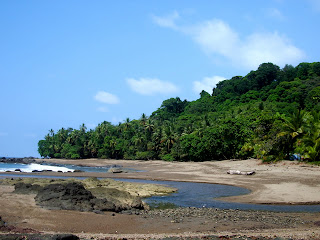
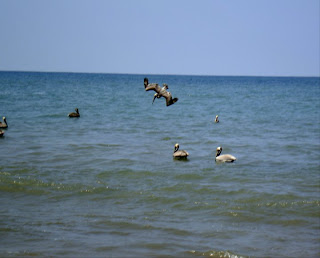
Today we split into groups and did mini research projects. We collected data in the morning, analyzed it and made a poster in the afternoon, and then presented our poster and findings after dinner. I had the best project: sitting on the beach watching pelicans. Our questions were, do juvenile, subadult, and adult pelicans spend different amounts of time fishing and do they have different success rates? We took turns watching a pelican in each age group for 30 minutes, counting how many dives it made and how many were successful. A successful fishing attempt was when a pelican swallowed whatever it caught in it's pouch/bill. Every hour, we also counted how many pelicans of each age group were sitting on rocks and how many were actively foraging. It was another hot, humid day, but we sat in the shade on the warm sand while a nice sea breeze kept the humidity at bay. I remained barefoot all day; it was fabulous.
Our analysis concluded that all age groups of pelicans were equally successful at catching fish, but the juvenile birds put in more effort. They were seen actively foraging the most, possibly because they need more food or are less efficient than adults because they haven't learned the proper technique. Indeed, we observed several juveniles splashing around comically and coming up empty-pouched. After our poster was finished, we cooled off in the ocean with our study subjects diving around us. New friends and I studied on the beach under the stars, and I went to bed excited for tomorrow's long hike through the rainforest.
description
Hannah Kornbrath's travels in Costa Rica during Spring 2011
Tuesday, March 8, 2011
Saturday, March 5, 2011
Feb. 11th: orientation to Corcovado
This morning I awoke with the sun at about 5:45. I laid on top of my borrowed sleeping bag, listening to the ocean and a cacophony of bird calls. I had no hope of trying to identify the birds by sound; I only know some of the most common ones at home, here they are all completely new. It was already quite humid, and I was pretty awake, so I got up to check out the birds. I gathered my binoculars and field guide and wandered down the beach towards the creek. Two Bare-throated Tiger Herons fought over fish near the rocks and a Social Flycatcher built its nest in a tree overhanging the creek. Most of the pelicans were still resting on the rocks near the sand. I also saw a Cherrie's Tanager flitting about in the palm trees. Not bad for a 45 minute stroll before breakfast.
We ate breakfast (rice, beans, eggs, watermelon, and pineapple) at the picnic table outside, looking out at the ocean, with more howler monkeys calling in the trees. I received some good news about my missing bag; it had been found on the boat, and I would get it back eventually. Yay!
At 8:00, we converged on the grassy area with hiking shoes, water, and species books. We split into four groups to walk a short ways and learn about the diverse array of plants and animals in Corcovado National Park. There is a species report for each of the 200 species that I have to know. A species report consists of checking out a species, and one of our professors or a student giving a 5-15 minute shpeel on the species' (but sometimes just the genus) natural history. Today we did species reports on several plants and animals, my favorite of which was the Norops lizard. This genus is usually known as anole lizards. They are small and fast. Mature males have a colorful flap of skin on their chins called a dewlap, which they use to look sexy for the female Norops.
This is definitely the coolest classroom ever. I get to see and touch and smell and experience the species I learn about in their natural setting. We're outside all day, immersed in tropical diversity. I don't know if my sense of awe at this place will ever wear off.
Lunchtime! We're lucky enough to have a team of cooks camping with us who cook and clean up after all our meals. This doesn't really feel like camping; I expected to have a chore list. I'm not complaining though. It's nice to not have to worry about that stuff. We can focus on enjoying the experience. Soon after lunch, we checked out the creek again. Lo and behold, there was the crocodile! Just chilling on the bank.
I also saw my first trogon, a female Slaty-tailed Trogon, perched in the tree above the picnic table.
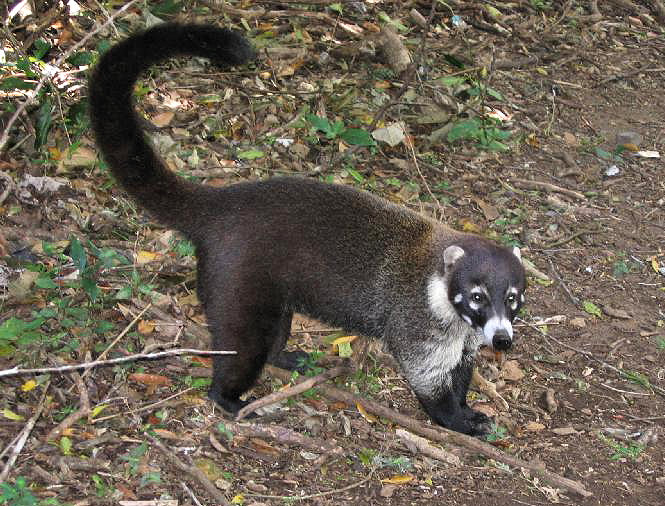
After lunch, we divided into groups again. While learning about more plants with Moncho, we watched a coati sniff around and then take a nap on a tree branch. Have I mentioned this is the coolest classroom ever?
We finished with scheduled activities in late afternoon. Most of us decided to take the 30 minute hike to the waterfall to cool down in the creek. Before we left, we spotted some howler monkeys in the trees right above our camp. A couple of them had babies clinging to their backs.
We returned from the waterfall hike in time for dinner. Later, I used the chilly outdoor showers while more howler monkeys called in the trees overhead. Best shower location ever. After some studying, we took the lanterns and some drinks to the beach. We chilled on the sand, talking and singing along with the people in the group who brought guitars. It was an awesome end to the day.
N.B. Some of these photos are mine, some are from friends, and some are from Google Images.
| Bare-throated Tiger Heron |
| Social Flycatcher |
| Cherrie's Tanager |
At 8:00, we converged on the grassy area with hiking shoes, water, and species books. We split into four groups to walk a short ways and learn about the diverse array of plants and animals in Corcovado National Park. There is a species report for each of the 200 species that I have to know. A species report consists of checking out a species, and one of our professors or a student giving a 5-15 minute shpeel on the species' (but sometimes just the genus) natural history. Today we did species reports on several plants and animals, my favorite of which was the Norops lizard. This genus is usually known as anole lizards. They are small and fast. Mature males have a colorful flap of skin on their chins called a dewlap, which they use to look sexy for the female Norops.
![]() |
| extending the male Norops' dewlap |
Lunchtime! We're lucky enough to have a team of cooks camping with us who cook and clean up after all our meals. This doesn't really feel like camping; I expected to have a chore list. I'm not complaining though. It's nice to not have to worry about that stuff. We can focus on enjoying the experience. Soon after lunch, we checked out the creek again. Lo and behold, there was the crocodile! Just chilling on the bank.
| a little blurry... |
After lunch, we divided into groups again. While learning about more plants with Moncho, we watched a coati sniff around and then take a nap on a tree branch. Have I mentioned this is the coolest classroom ever?
| Coatis are in the same family as raccoons |
![]() |
| At the waterfall |
N.B. Some of these photos are mine, some are from friends, and some are from Google Images.
Saturday, February 26, 2011
Feb. 10th: mangrove tour, boat to Corcovado
| Learning about the water hyacinth (Eichhornia crassipes) |
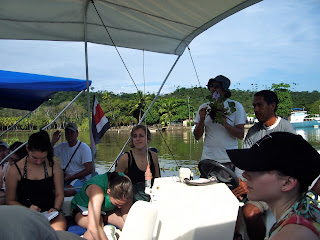
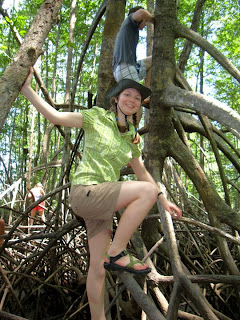
It was always a welcome respite from the humidity when the boats moved quickly. My shirt was damp with sweet for most of the morning, until we stopped at a swimming hole. However, we had to climb over Red Mangrove (Rhizophora mangle) roots to get there. It was like a giant jungle gym, with deep mud below. I felt like a little kid on the playground.
![]() |
| I love my sun/rain hat |
| Katie with a Red Mangrove Crab (Aratus pisonii) |
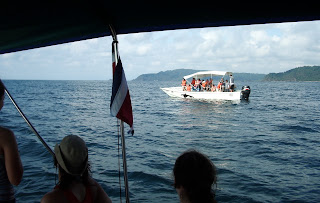
| the dolphins are underwater |
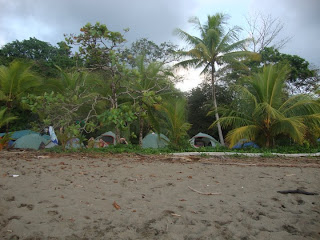
| the beach at San Pedrillo, just to the north of a small creek that flows into the river |
![]() |
| looking up the beach at our tents |
| can you say, tropical paradise? |
| our classroom |
![]() |
| Brown Pelicans diving off the beach |
| Scarlet Macaws through my binos |
Later, my tentmate, Rebecca, and I went for a walk in the freshwater creek just to the south of our camp. We saw a Green Heron, Green Kingfisher, and Boat-billed Herons. We also had a messy and fun mudfight with a few other people.
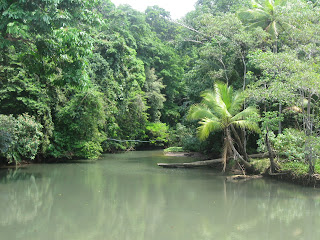
| the creek near our camp |
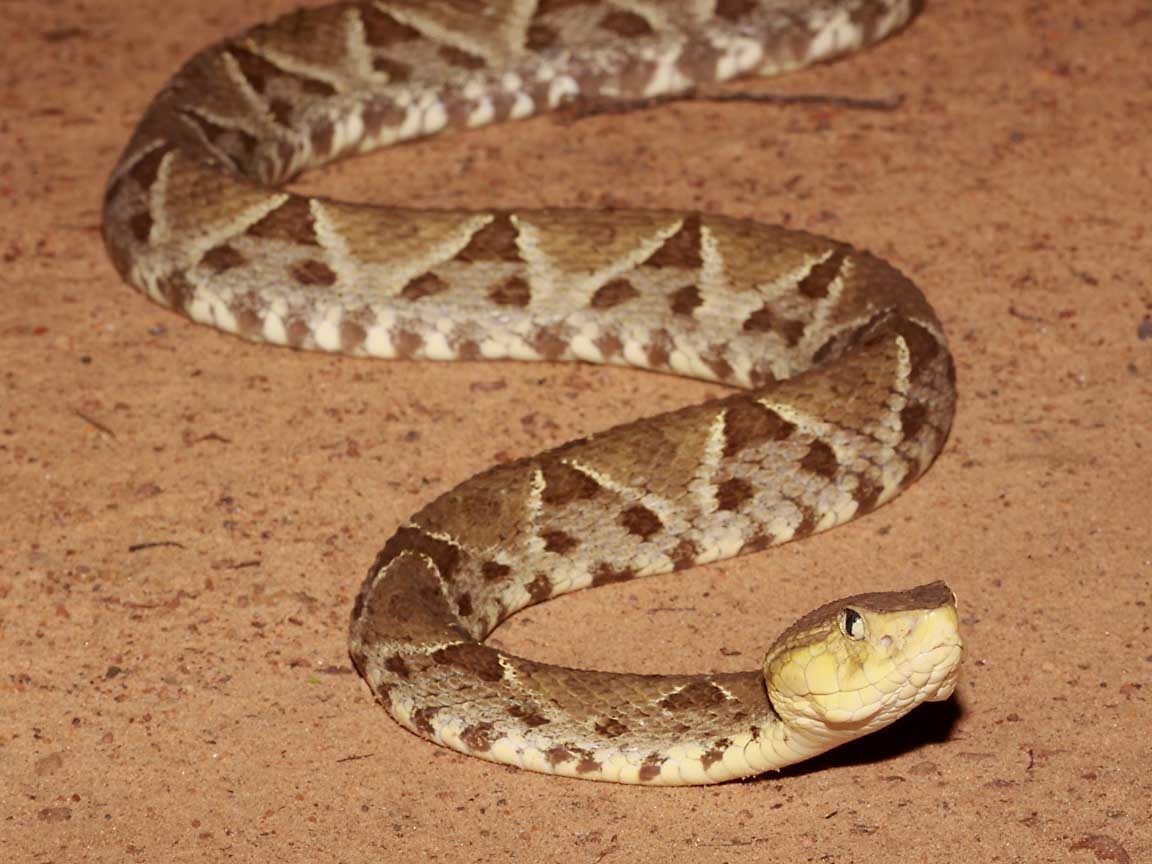
| fer-de-lance: don't touch |
Later, we all sat around the picnic tables on the porch, making flashcards and studying the species by lantern light. Moths, flies, large cicadas, and other insects buzzed around our lights. If a particularly interesting insect flew by, we'd stop studying for a few minutes to check it out and try to identify it. I love that the other 29 students on this trip are as fascinated and excited by the natural world as I am. Sure, my friends at home tolerate my inner biology nerd, tease me a little, and maybe even think it's kind of cool, but it's more fun when others can share in my excitement.
| cicada (Fidicina mannifera) |
Feb. 9th: traveling, Cartago, Cerro de la Muerte, and Sierpa
We woke up pretty early to pack the bus: our large duffle bags went on a truck bound for Monteverde, while our daypacks and smaller bags came with us on the charter bus. After breakfast, we boarded the bus and finally left the city. The scenery changed from crowded streets and building to fields and scrubby forests interspersed with tin-roofed dwellings. We stopped in Cartago, where the most famous church in Costa Rica stands- Basílica de Nuestra Señora de Los Ángeles. Many pilgrims journey to the Basilica each year to drink the natural spring's holy water and ask the Virgin of the Angels to heal them.
| the Basilica |
| inside the Basilica, all of the wood is mahogany |
| the location of the holy spring |
Our next stop was Cerro de la Muerte (Hill of Death) to experience a high elevation (3000 m) wet forest. We walked up the trail a short way, stopping in a clearing to hear about several plant species and páramo habitat. The páramo consists of scrubby vegetation and grasses above the tree line. We also searched unsuccessfully for the mountain salamander (Bolitoglossa subpalmata). Back down the trail, we had lunch at the small tourist restaurant. I watched Green Violet-ear, Purple-throated Mountain-gem (my first top 17!), and Magnificent hummingbirds from the windows.
| Alan lectures on the Black Oak (Quercus costaricensis) |
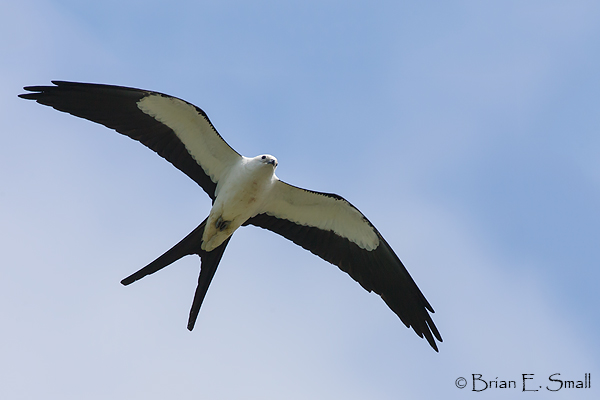
Back on the bus, the scenery changed from high to low altitude vegetation. Even though it was too bumpy to use my binoculars, I was able to spot the distinctive silhouette of a swallow-tailed kite.
Our next stop was a pineapple field, where we learned about the biology and agriculture of this domesticated bromeliad (a member of the Bromeliaceae plant family). I learned why it sometimes hurts your tongue to eat pineapple: the fruit's center contains meat-tenderizing properties, which breaks down the tongue muscle. If you simply avoid the pineapple's center, you can avoid a tenderized tongue. We also sampled some of the fresh, juicy crop.
| check out all those Ananas comosus |
| baby pineapple |
![]() |
| om nom nom |
We finally arrived in the tiny town of Sierpa after dark. Our hotel was...rustic. Alan warned us that flushing toilet paper would jam up the sensitive septic system. The showers randomly stopped working for a couple hours, and then would flip-flop rapidly between a drizzle and a downpour. However, the open-air restaurant was very tasty. We stayed in the restaurant for a lecture in preparation for tomorrow's mangrove tour. The professors let us order a drink from the bar, so we took lecture notes while enjoying cervesas in the warm night air and listening to geckos chirp.
Friday, February 25, 2011
Many updates to come in the next few days
I'm now in Monteverde at the Biological Station. The two week field trip was amazing, we went to some incredible places and saw some really cool species. My favorite moment of the trip was cooling off in a freshwater creek with friends right near the ocean, then sitting on the rocks and watching the sunset while howler monkeys, spider monkeys, and white-faced capuchins foraged in the trees overhead and scarlet macaws flew by. I'll be making posts for each day of the field trip in the coming days, so stay tuned.
Tuesday, February 8, 2011
Leaving on the first field trip tomorrow
Today was another busy day of class and adventuring in San José. Pablo, one of our professors, taught us about the impact of humans on the earth, and then sent us out to interview locals at La Universidad de Costa Rica (University of CR) about their ecological footprints. There is an interesting paradox: Costa Rica is known for its environmental awareness- about 25% of the land is national parks- yet most people in San José don't visit these parks and aren't very sustainable themselves. Part of this has to do with a lack of money and infrastructure; for example, there is no organized recycling in Costa Rica due to unpredictable politics and insufficient funds.
We also visited the museo (museum) and learned about Costa Rica's history and pre-Columbian indigenous populations. It was a lot of fascinating information, and I need to get some sleep tonight, so I'm sorry I can't summarize it all right now. Tomorrow we leave for a two week trip along the Pacific coast, starting in the south and working our way north, and then on to Monteverde. I'm excited to get out of the city. It's crowded, loud, and dirty. It was fun for a couple days, but now I'm ready to see what I came here for- rainforest and wildlife (such as birds!). I won't have my computer or internet for the next two weeks, so it'll be awhile until my next update. In the meantime, here are some photos of San José. There's about 40 more on Facebook that you might want to check out as well.
| Walking down la Avenida Central. Drivers don't always obey the stoplights. |
| Fruit/vegetable stand at the Central Market |
| On the way to the Museo |
| At the Museo |
| At the Museo |
| Gold decor at the Museo |
| Note the large ditch between the road and the sidewalk...possibly for excess rainwater during the rainy season? Also used as a garbage bin :( |
Monday, February 7, 2011
I'm here! in San José
I made it to San José, the capital of Costa Rica, last night at about 9:00 pm. I wish I could've seen the forest as we flew over, but all I saw were the bright city lights in the dark. Two other people from my program were on my flight. We were relieved to find our program coordinator, Kathy, waiting outside. She welcomed us and directed us to a taxi. The taxi zoomed along the narrow streets to our hotel, Hotel Balmoral. I found my room and deposited my heavy bags, then met the rest of the students and trip leaders. We all went out for cervesas (Imperial es la cervesa de Costa Rica, apparently) at the bar across the street. It seems like a great group of people; everyone's very friendly and excited about biology. There are thirty students total; four others from my school and many from Colorado and the Midwest.
This morning was early; a yummy breakfast at 7:30 and orientation at 8:00 am upstairs in a conference room. Alan, the program director, introduced us to the history and culture of Costa Rica. Costa Rica is one of the most stable countries in Central America; they disbanded their army in 1948 and have government-funded, universal health care. Catholicism is the official religion, and about 87% of the population is of European decent. Costa Ricans, or Ticos, as they call themselves, are in general very friendly and helpful. They appreciate the economic boost from gringo (American) tourists. After his lecture, Alan gave us an assignment: go out into the market place and find a certain fruit or plant part, learn about it, have lunch, explore, then return to the hotel conference room at 2:00 pm. We set out on our mission, I had higo, a fig.
San José is a busy city. Pedestrians crowd the Avenida Central, which is a pedestrian-only street that divides the city north-south. On either side are shops, cafés, trees, street performers, cart stands, people, pigeons, and more people. It was about 80° F and sunny today. A cool breeze kept the humidity in check. I wore a skirt and t-shirt...in February. We split into smaller groups to navigate the narrow passageways of the central market, a large building with many booths selling everything from postcards and other trinkets to herbs and seafood. My out-of-practice Spanish came in handy when asking for higos, which were 200 colones, or about $0.40 American.
We had lunch at the Teatro Nacional, the national theater. This beautiful building opened in 1897. I also saw a great-tailed grackle outside the theater, which I've seen in Malheur, OR.
At 2:00, we settled back into the conference room for a long but interesting lecture on Division Anthophyta, flowering plants. There was some review of flower parts and basic botany, but we had the opportunity to examine some flowers and identify the pistils, carpels, stamens, petals, and sepals ourselves. Moncho, one of our TAs, gave us an overview of fruits. I learned a lot from his lecture; much of what we call vegetables or nuts are actually fruits, and things like blackberries aren't berries but aggregate fruits, while oranges, avocados, and pumpkins are berries. It all depends on what part of the flower develops into what part of the "fruit." We presented our assigned fruits to the class as well. My fig "fruit" is actually composed of lots of tiny flowers folded up into a hollow bulb. The base of the flowers are full of sweet juice, which makes the fig edible.
But wait, I'm sure you're wondering, why would a plant "want" to have its flowers inside a hard bulb? How would they ever get pollinated? Well, there is a very specialized insect called the fig wasp, which has co-evolved with the figs. The fertilized female wasp crawls inside a small hole at the base of the fig. The opening is so small that her wings are ripped off in the process, so she is trapped inside. She rubs against the flowers, pollinating them while she lays her eggs, and then dies. Eventually, the larvae hatch and also inadvertently rub against the flowers, collecting pollen. The male wasp larvae mate with the females inside the figs (yes, their siblings...no, I'm not sure how the wasps have any genetic diversity). The males chew a tunnel to the outside of the fig and then soon die. The mature, fertilized females escape and go on to lay their eggs and spread pollen in another fig. Isn't biology amazing?
After all that learning, the program leaders took us out to a tasty dinner. I had some delicious rice and beans and chicken and fried plantains (bananas). Actually, I didn't really like the plantains, no me gusta bananas. The TAs took us out to drinks afterwards, more cervesa Imperial. Tomorrow is another long day in San José, and then Wednesday we leave for our first camping trip along the Pacific coast. I'm really looking forward to seeing some actual rain forest and wildlife other than pigeons and feral dogs.
![]() |
| Costa Rica is gold-yellow on this map, with Nicaragua to the north and Panama on the south border. |
![]() |
| San Jose is near the middle of the country, in the Central Valley. Monteverde is more north. See map enlarged |
San José is a busy city. Pedestrians crowd the Avenida Central, which is a pedestrian-only street that divides the city north-south. On either side are shops, cafés, trees, street performers, cart stands, people, pigeons, and more people. It was about 80° F and sunny today. A cool breeze kept the humidity in check. I wore a skirt and t-shirt...in February. We split into smaller groups to navigate the narrow passageways of the central market, a large building with many booths selling everything from postcards and other trinkets to herbs and seafood. My out-of-practice Spanish came in handy when asking for higos, which were 200 colones, or about $0.40 American.
We had lunch at the Teatro Nacional, the national theater. This beautiful building opened in 1897. I also saw a great-tailed grackle outside the theater, which I've seen in Malheur, OR.
![]() |
| Not my photo |
But wait, I'm sure you're wondering, why would a plant "want" to have its flowers inside a hard bulb? How would they ever get pollinated? Well, there is a very specialized insect called the fig wasp, which has co-evolved with the figs. The fertilized female wasp crawls inside a small hole at the base of the fig. The opening is so small that her wings are ripped off in the process, so she is trapped inside. She rubs against the flowers, pollinating them while she lays her eggs, and then dies. Eventually, the larvae hatch and also inadvertently rub against the flowers, collecting pollen. The male wasp larvae mate with the females inside the figs (yes, their siblings...no, I'm not sure how the wasps have any genetic diversity). The males chew a tunnel to the outside of the fig and then soon die. The mature, fertilized females escape and go on to lay their eggs and spread pollen in another fig. Isn't biology amazing?
After all that learning, the program leaders took us out to a tasty dinner. I had some delicious rice and beans and chicken and fried plantains (bananas). Actually, I didn't really like the plantains, no me gusta bananas. The TAs took us out to drinks afterwards, more cervesa Imperial. Tomorrow is another long day in San José, and then Wednesday we leave for our first camping trip along the Pacific coast. I'm really looking forward to seeing some actual rain forest and wildlife other than pigeons and feral dogs.
Subscribe to:
Posts (Atom)